

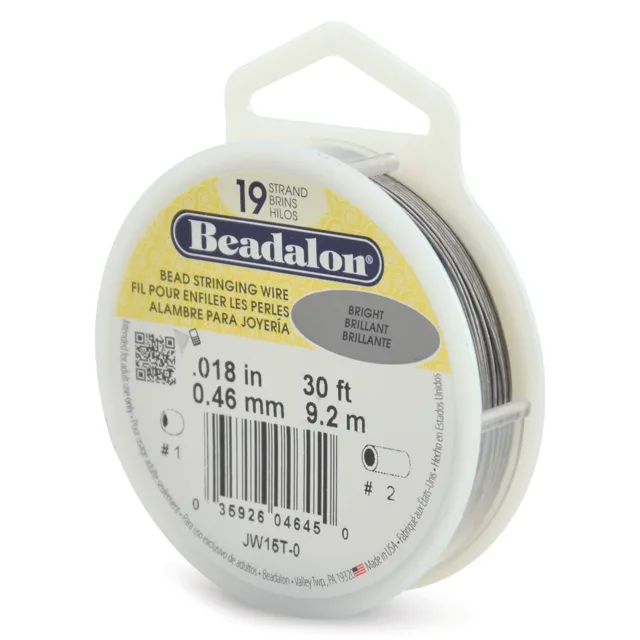
Beadalon 19 Strand Bead Stringing Wire Review
We may earn a commission from some links on this page.
Beadalon 19 Strand Bead Stringing Wire is a spooled beading wire for stringing beads, and the listing that matters here is Blick's: item 63843-1200, the 19-strand wire in Bright, 0.018 in, on a 30 ft spool. Those four details — strand count, colour, diameter and length — are the whole of what the page describes. It does not name the metal, describe the coating or list the other sizes the range comes in. The shop does list a 49-strand wire in exactly the same 0.018 in Bright 30 ft format, so the two can be compared directly, and a Beadalon looping tool sits beside both. Here is what the listing states, what it leaves open, and the questions worth settling before you order.
Key Takeaways
- Beadalon 19 Strand is a 19-strand bead stringing wire, sold on a 30 ft spool.
- Blick lists this spool as 0.018 in wire in the Bright colour.
- A 49-strand version of the same wire is listed in the same 0.018 in, Bright, 30 ft format.
- The page gives strand count, diameter, colour and length, and does not describe the metal or the coating.
- Beadalon's standard wire looping pliers are sold alongside it for finishing the ends.
Bead Stringing Wire
Bead stringing wire is the spooled alternative to thread for beadwork: instead of knotting a soft thread between beads, a piece is strung on wire that holds a line and finishes with a crimp or a loop at each end. The wire is sold on spools by diameter, and the diameter is where a buyer usually starts, because it has to pass the hole of the smallest bead in the design.
The product name carries the other half of the specification. A Beadalon wire is named by strand count, and this is the 19-strand entry. The shop also lists a 49-strand wire in the same diameter, so between the two pages the count is the one thing that changes while the size, colour and length stay put.
What the listing does not do is describe the wire's construction. It does not say what metal the strands are, whether they carry a coating, how much weight the wire holds or which sizes and colours the range comes in. Those are reasonable things to want before buying a spool, and they have to come from the maker or the shop rather than from this page.
Read that way, the page is a specification rather than a description. It establishes that the 19-strand wire exists in 0.018 in and Bright on a 30 ft spool, and it puts a 49-strand alternative in the same format beside it. Everything past those four lines — the metal, the coating, the feel of the wire in the hand — is outside what the shop states.
What the 19-Strand Build Changes
The 19-strand wire and the 49-strand wire are listed in the same 0.018 in diameter, the same Bright colour and the same 30 ft length, so the strand count is the only thing that separates them. Beadalon builds the higher counts from finer strands, which is why the 49-strand version is the finer build of the two and the one usually chosen when a piece needs more drape.
That also means the choice between the two is not a question of fit. At 0.018 in both spools are the same diameter, so the count is about how the wire behaves in the work rather than whether it will pass through a bead. The two listings together are what make that comparison possible.
Consider these attributes:
| Feature | What the listing shows |
|---|---|
| 19 strands | The strand count in the product name |
| 0.018 in | The diameter the shop lists |
| Bright | The colour the shop lists |
| 30 ft spool | The length the shop lists |
| 49-strand option | Same diameter, colour and length, in a finer build |
Whether 19 strands is the right count for a given piece is a judgement about the work rather than a fact on the page. What the page does settle is the comparison: at the same size and colour, the 49-strand spool is the finer build and this one is the standard 19-strand.
Detailed Features
Blick's product details for this spool are short, and the strand count is the one specification carried by the name rather than by the table.
The page gives the diameter, the colour and the length, plus the item number and a UPC. Nothing there describes the metal, the coating, the finish beyond the word Bright, the breaking strength or the range of sizes the wire comes in.
Blick lists the 0.018 in spool as 0.018 in wire, 30 ft long, in the bright colour, item 63843-1200. The same page carries a second Beadalon spool in the same format with a different strand count, and that is the only comparison the shop offers between the two builds.
| Detail | What it means |
|---|---|
| 19 strands | The strand count in the product name |
| 0.018 in | The diameter the shop lists |
| Bright | The colour the shop lists |
| 30 ft spool | The length of the spool |
| Item 63843-1200 | The shop's item number for this spool |
Those lines cover the whole of the specification: 19 strands, 0.018 in, Bright, 30 ft. The questions a beadworker would normally ask next — what the strands are made of, what the coating is, how the wire behaves after a few weeks of wear — are not answered on the page, and this review does not fill the gap with guesses.
Advantages and Disadvantages Overview
A four-line listing makes for a short set of trade-offs, and the honest ones come from the comparison the shop makes possible rather than from claims about how the wire performs.
Here’s a quick overview:
| Aspect | Advantage | Disadvantage |
|---|---|---|
| Strand count | 19 strands is one of two counts listed at this size | The listing does not say what the count changes |
| Diameter | 0.018 in is a fine wire | Only one diameter is listed on this page |
| Colour | Bright is listed and easy to match | One colour only on this page |
| Length | A 30 ft spool goes a long way in small work | No other spool length is listed |
The one comparison the shop does make possible is with the 49-strand wire, listed at the same 0.018 in, Bright and 30 ft. Read together, the two pages let a buyer pick a strand count without changing size, colour or length; read alone, this page is a specification and little else.
Ideal for Intricate Beadwork
For intricate beadwork, a plain specification is an advantage: the diameter and the strand count are known before the first bead goes on.
Multi-strand stringing wire is the usual choice where a design needs the stringing material to bend through tight curves without taking a permanent set, and this spool gives you the 0.018 in diameter to check against the smallest bead hole in the design. What the page does not describe is how this particular wire bends or how it sits after a few weeks in a piece, so the feel of it is something to judge from the maker's own description or a sample rather than from the listing.
Key facts from the listing:
- 19 strands: the build the product name specifies.
- 0.018 in: the diameter the shop lists for this spool.
- 30 ft: the length on the spool.
- Bright: the colour the shop lists.
Frequently Asked Questions
Can This Wire Be Used for Outdoor Jewelry Projects?
The listing does not name the metal or the coating, so it cannot tell you how the wire stands up outdoors. Whether a finished piece suits outdoor wear depends on the beads and findings as much as on the wire, so treat a wire-strung piece like any other jewellery and take it off for swimming.
Is the Wire Hypoallergenic for Sensitive Skin?
The page does not state what the wire is made of beyond the strand count, so it does not claim anything about sensitive skin. If you have a known metal sensitivity, ask the shop what the strands and coating are before you order.
How Does This Wire Compare to Silk Thread?
When comparing the wire to silk thread, it’s like apples and oranges. The wire has more body and does not need knotting between beads, while silk gives a softer, knotted string with more drape. Pay attention to the design’s needs to choose appropriately.
What Is the Maximum Weight Capacity of the Wire?
The listing gives no breaking strength or weight rating, so there is no figure to quote. The weight a piece can take depends on the wire diameter rather than on one fixed number, and the length of the necklace matters as much as the beads; for a heavy pendant or large stone beads, ask the shop for the rating of the diameter you intend to buy.
Does the Wire Require Special Tools for Cutting?
Yes. A multi-strand wire needs a sharp pair of wire cutters rather than scissors, because a clean cut keeps the strands from fraying at the end. Trim any loose end flush afterwards and it will sit tidily in a crimp or loop.