
Retrolife ICE1-V2 Review
We may earn a commission from some links on this page.
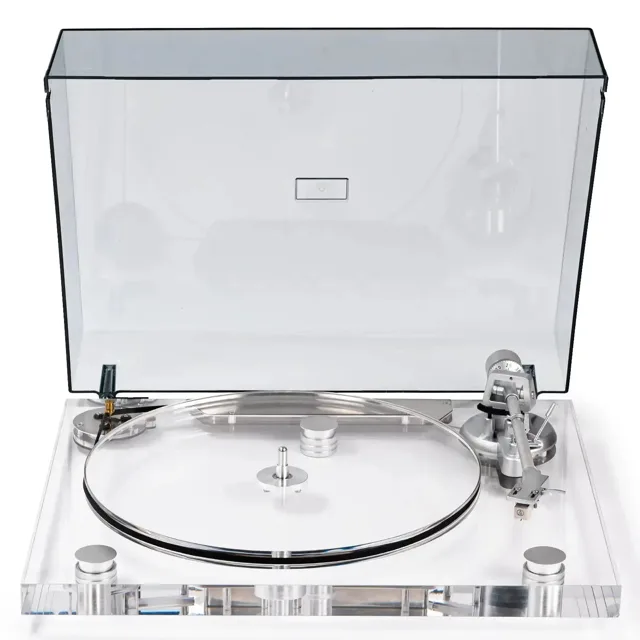
The Retrolife ICE1-V2 is a manual belt-drive turntable built around a clear acrylic body. Retrolife pairs a 30 mm acrylic chassis with a 20 mm acrylic platter, fits an Audio-Technica AT3600L moving-magnet cartridge and adds three things that make it easy to live with: a switchable built-in phono stage, Bluetooth 5.3 output and a USB connection for recording records to a computer. It has no speakers of its own and it plays at 33 1/3 and 45 RPM. What follows is what the deck is made of, how those parts work together, and what you need alongside it.
Table of Contents
Key Takeaways
- Clear acrylic construction: a 30 mm chassis under a 20 mm platter.
- Manual belt drive at 33 1/3 and 45 RPM, for 7, 10 and 12 inch records.
- Pre-mounted Audio-Technica AT3600L moving-magnet cartridge with a replaceable conical stylus.
- Built-in switchable phono stage, RCA output, Bluetooth 5.3 output and USB recording to a computer.
- No built-in speakers, so it needs powered speakers, an amplifier or Bluetooth speakers and headphones.
Acrylic Plinth and Platter
The most obvious thing about the deck is that you can see through it. Retrolife builds the chassis from 30 mm of clear acrylic and sits a 20 mm acrylic platter on top, with a 12 inch platter diameter. The maker's description gives the reason for the material: acrylic is dense and shares a resonant frequency with vinyl, so the mass is there to absorb mechanical vibration before it reaches the record rather than to add features. The practical result is a deck with a solid plinth and a platter that is part of the design rather than hidden under a mat.
Drive is a manual belt system. A belt runs from the motor to the platter, which separates the motor from the platter and keeps motor noise away from the playing surface. There are two speeds, 33 1/3 and 45 RPM, selected on the deck, and the maker lists support for 7, 10 and 12 inch records, so singles and LPs are both covered. A 45 RPM adapter, a slipmat and a dust cover are in the box. You place the arm and cue it with the lever yourself, and the deck lists an auto-stop for the end of a side.
Tonearm and Cartridge
The arm is a solid aluminium straight tonearm with an adjustable counterweight. The counterweight has a numbered dial, and the deck's recommended tracking force is 3.0 grams plus or minus 0.5 grams, which is the range the counterweight is designed to set. Setting it follows the usual sequence: balance the arm so it floats level, set the dial to zero, then turn the weight to the number you want. A straight arm with a fixed headshell keeps alignment simple and reduces the number of parts between the record and the cartridge.
The cartridge is an Audio-Technica AT3600L moving-magnet model, fitted at the factory and pre-mounted. Its stylus is a 0.6 mil conical diamond, and it is a replaceable part: the deck takes a standard ATN3600L replacement stylus, so when the needle wears you change the stylus rather than the whole cartridge.
Phono Stage, Bluetooth and USB
This is where the Retrolife ICE1-V2 earns its place in a simple system. A moving-magnet cartridge puts out a very small signal that needs a phono stage before it reaches an amplifier, and not every turntable includes one. Retrolife builds one in and makes it switchable. On the back there is a Line/Phono switch: set it to Line when you connect powered speakers or an auxiliary input, and set it to Phono when you connect a receiver or amplifier that has its own phono input. If the switch is in the wrong position the sound is quiet or distorted.
Output is through RCA sockets, and an RCA cable comes in the box. There is also Bluetooth 5.3 output, so the deck can send audio straight to Bluetooth speakers or Bluetooth headphones without any cable at all. That changes how the deck can be used: it can sit on a shelf away from the hi-fi and still play through a wireless speaker. Bluetooth here is output only, not input.
The USB port is for recording. Retrolife describes the process in three steps: connect the deck to a computer with the USB cable, open your recording software, and press play. The USB cable is included. You supply the computer and the software, and the deck handles the rest.
Detailed Features
Taken together, the specifications describe a deck that is simple mechanically and well connected for a manual turntable. The table below collects what Retrolife lists.
| Specification | What the maker lists |
|---|---|
| Drive | Manual belt drive |
| Speeds | 33 1/3 and 45 RPM (manual selection) |
| Record sizes | 7, 10 and 12 inch |
| Platter | 20 mm clear acrylic, 12 inch diameter |
| Chassis | 30 mm high-density clear acrylic |
| Tonearm | Solid aluminium straight tonearm |
| Counterweight | Adjustable, numbered dial |
| Tracking force | 3.0 grams plus or minus 0.5 grams |
| Cartridge | Audio-Technica AT3600L moving magnet, pre-mounted |
| Stylus | 0.6 mil conical diamond, replaceable with ATN3600L |
| Phono stage | Built in, switchable Line/Phono |
| Outputs | RCA, Bluetooth 5.3 output, USB to computer |
| Speakers | None built in; external speakers required |
| In the box | Dust cover, slipmat, 45 adapter, RCA cable, USB cable, power adapter |
Advantages and Disadvantages
The deck makes a clear set of trade-offs. It puts the money into the plinth, the platter and the connections rather than into built-in speakers, so it suits one kind of buyer and asks a little more of another.
| What stands out | What to know |
|---|---|
| Clear acrylic plinth and platter | No built-in speakers, so a system is part of the cost |
| Built-in switchable phono stage | Auto-stop: listed as yes |
| Bluetooth 5.3 output for wireless speakers or headphones | Bluetooth is output only |
| USB recording to a computer | Recording software is not supplied |
| Replaceable stylus on a pre-mounted cartridge | Two speeds, so no 78 RPM records |
What It Suits
The Retrolife ICE1-V2 fits most naturally into a small system. With the built-in phono stage set to Line, it can feed powered speakers directly, which is the shortest path from a record to sound. If you already have an amplifier with a phono input, set the switch to Phono and use the amplifier's stage instead. If you would rather not run cables across the room, Bluetooth output lets it play through a wireless speaker or a pair of headphones.
It also suits someone who wants to digitise a collection. USB recording turns the deck into a bridge between vinyl and a computer, and because the phono stage is already inside, you do not need a separate box between the turntable and the PC. What it does not have is a speaker or an automatic arm return, so anyone who wants a one-box record player, or who would rather not set tracking force by hand, should look at an all-in-one design instead. For a listener who is happy to set up a manual deck and wants the flexibility of wired, wireless and USB in one turntable, the feature list covers a lot of ground.
Frequently Asked Questions
Does the ICE1-V2 Have a Built-in Phono Stage?
Yes. The deck has a built-in phono stage with a Line/Phono switch on the back. Use Line for powered speakers or an auxiliary input, and Phono for an amplifier or receiver with its own phono input.
Can It Record Vinyl to a Computer?
Yes. The deck has a USB connection for recording to a PC. Retrolife's three steps are to connect the USB cable, open your recording software and press play. The USB cable is included; the computer and the software are not.
Does It Have Bluetooth?
Yes, Bluetooth 5.3 output. It sends audio to Bluetooth speakers or Bluetooth headphones. It does not accept a Bluetooth input.
What Cartridge and Stylus Does It Use?
It comes with an Audio-Technica AT3600L moving-magnet cartridge fitted at the factory. The stylus is a 0.6 mil conical diamond and can be replaced with an ATN3600L stylus.
Does It Have Built-in Speakers?
No. It is a turntable only, so you need powered speakers, an amplifier with speakers, or Bluetooth speakers or headphones.
What Speeds Does It Play?
33 1/3 and 45 RPM, selected on the deck, with support for 7, 10 and 12 inch records. A 45 RPM adapter is included.