
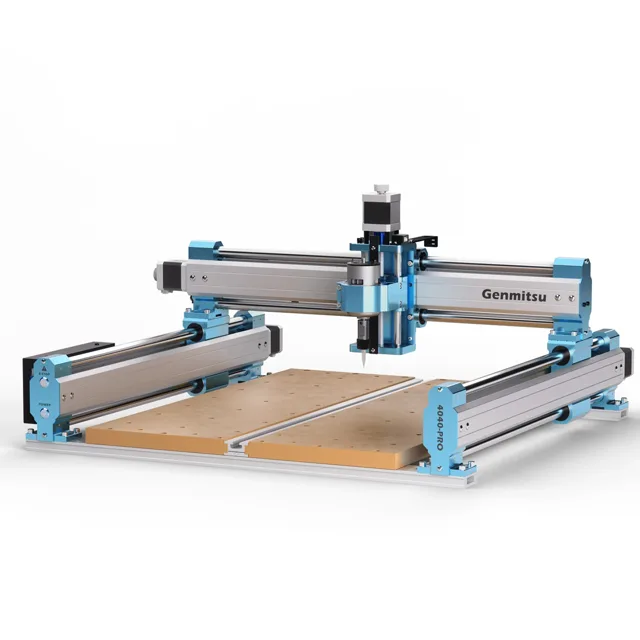
Genmitsu 4040-PRO CNC Router Review
We may earn a commission from some links on this page.
The Genmitsu 4040-PRO is a desktop CNC router with a working area of about 400 x 400 mm and 78 mm of Z travel, an all-aluminium frame on lead screws, and a GRBL control board. It arrives semi-assembled: the shop says the main parts come put together and around fifteen minutes of work is left. This review sets out what the listing states, what those numbers mean for the kind of work a router this size does, and where its limits sit.
Key Takeaways
- A desktop CNC router with a working area of about 400 x 400 x 78 mm.
- Semi-assembled: the shop says the main parts arrive put together and about fifteen minutes of assembly is left.
- All-aluminium frame on lead screws, with NEMA17 stepper motors and a GRBL control board.
- A 75 W spindle, listed as upgradable, with mounts for 65 mm and 69 mm spindles sold separately.
- Running accuracy is listed at plus or minus 0.1 mm, with limit switches and an emergency stop.
What Arrives and How It Goes Together
The listing says the machine is semi-assembled and that the whole assembly takes about fifteen minutes, because the main parts are already put together and located with pins and grooves. What is left is bolting the frame sections together, fitting the Z-axis module and spindle, and squaring the machine up before the first cut.
The box contents are listed as the Z-axis module with the spindle pre-assembled, plus two ER11 collets, one at 4 mm and one at 3.175 mm. A collet is the part that grips the bit, so those two sizes cover the common 4 mm and 1/8 inch shank bits. Three 30-degree conical V bits come in the box, which is enough to start engraving; a wider bit set, and a dust shoe, are extras.
Assembly time is not the same as setup time. After the frame is together the machine still needs its spoilboard fitted, the axes checked for square, and a first test cut run to confirm the steps per millimetre are right. That part is where a new owner learns the machine.
Frame, Axes and Control
The frame is listed as all aluminium, with a lead screw drive on all three axes. That matters for a router this size: lead screws hold their position when the machine is not cutting, where a belt drive can be pushed out of place by a heavy cut. The trade is speed, and the machine is listed at a maximum of 2000 mm per minute, which is a working speed rather than a fast one.
Motion comes from NEMA17 stepper motors, and the control board is GRBL, which is the open firmware most hobby routers use. That means the machine talks to the usual senders over USB and accepts standard G-code, so files from most CAM programs will run. Limit switches are fitted on the axes and there is an emergency stop button on the machine.
The control board also has dedicated ports for a 3-pin laser module, an air-assist pump and an MPG hand controller. None of those are in the box; the point is that the machine can grow into them later without replacing the board.
Detailed Features
The shop's specification is set out below as listed, so the numbers can be checked against the work you have in mind.
| Feature | What the shop lists |
|---|---|
| Working area | 400 x 400 x 78 mm (15.75 x 15.75 x 3.1 in) |
| Frame | All aluminium |
| Drive | Lead screw, X, Y and Z |
| Motors | NEMA17 42 stepper |
| Spindle | 75 W, upgradable, up to 9000 RPM |
| Max speed | 2000 mm per minute |
| Accuracy | Plus or minus 0.1 mm |
| Control | GRBL board, USB, limit switches, emergency stop |
| Power supply | 24 V, 4 A |
| Machine size | 673 x 663 x 336 mm |
| Weight | 20.65 kg (45.5 lb) |
| In the box | Z-axis module with spindle, ER11 collets 4 mm and 3.175 mm, three 30-degree V bits |
The spoilboard is listed as a reinforced hybrid type with a central aluminium support bar and an integrated T-track. In plain terms, that is a bed that resists sagging under load and gives you slots for clamping work down, which is the difference between cutting a flat pocket and cutting one that is deeper in the middle.
Spindle, Work Area and Materials
The spindle is 75 W and listed as upgradable. That is a small spindle: it is made for light passes in wood, plastic and foam rather than deep cuts in hardwood or aluminium. A 75 W spindle will engrave, cut thin stock and shape soft materials, but it is not the tool for production work in thick timber, and the listing is honest about that by calling the spindle upgradable.
The Z-axis carriage takes 65 mm and 69 mm spindle mounts, sold separately, which is what makes an upgrade practical: a larger spindle can be bolted on without changing the frame. The working area of 400 x 400 mm is enough for sign panels, small cabinet parts, guitar bodies and jigs. The 78 mm of Z travel sets the thickness of stock you can fit under the bit, and the machine's clearance above the bed is the other half of that limit.
The listing is written around carving, cutting and woodworking projects rather than a material list. A router of this size is normally used on wood, MDF and plastics, and the frame and spindle suit that range. Hardwood, aluminium and brass are a stretch for a 75 W spindle, and the machine should not be bought expecting to cut them at any speed.
Software and Control Options
Because the board is GRBL, the machine does not come tied to one program. Any sender that speaks GRBL will drive it over USB, and design work happens in whatever CAD or CAM package you already use: you draw the part, generate a toolpath with the right bit and feeds, and send the G-code.
The board supports the CTL4040 offline controller and an MPG handwheel, neither of which is in the box, so the machine can be run without a computer later. That is worth knowing if the router will live in a shed away from a PC. Until then, a laptop and a sender is all that is needed to start.
Advantages and Disadvantages Overview
Weighed up plainly, this is a capable hobby router with a small spindle, and both halves of that sentence matter.
| Strengths | Limits | What it means for you |
|---|---|---|
| 400 x 400 mm work area | Desk-sized footprint at 20.65 kg | Real project space, needs a sturdy bench |
| Lead screws on all axes | 2000 mm per minute top speed | Holds position; slower than a belt machine |
| Semi-assembled, about 15 minutes | Only three V bits in the box; no dust shoe | Quick to build, budget for tooling |
| Upgradable spindle mounts | 75 W spindle is light duty | Starts small, can grow into a bigger spindle |
| GRBL, so any sender works | You choose and learn the CAM software | No lock-in, but some learning required |
None of the limits is a fault at this size. They are the normal trade-offs of a desktop router with a small spindle, and they only become problems if you buy it expecting to cut thick hardwood all day.
Frequently Asked Questions
How Does the Machine Handle Complex Engraving Designs?
Engraving is the job this machine is best at. The listed accuracy is plus or minus 0.1 mm, and with a small V-bit or engraving bit a 75 W spindle has enough power for shallow passes in wood and plastic. The limit is the toolpath, not the machine: fine lettering needs a small bit and a slow feed, and the CAM file has to be set up for that.
Can the Router Machine Work With Non-Standard Materials?
The listing is written for carving and cutting, mostly around woodworking projects, and the frame and spindle suit light work in wood, plastics and composites. Materials outside that range, such as aluminium or dense hardwood, need a bigger spindle and much lighter passes than a 75 W unit will manage comfortably. Test any unfamiliar material on scrap before committing a project to it.
What Is the Average Lifespan of the Spindle Motor?
The shop does not list a spindle life, so there is no figure to quote. Spindles of this type last according to how hard they are run and how long they are left cutting at full load; light passes and a break between long jobs are the usual way to get a reasonable life out of one.
Are There Third-Party Parts Compatible With This CNC Model?
Bits are standard: the machine takes ER11 collets in 4 mm and 3.175 mm, so any bit with those shanks fits. Spindles need to match the 65 mm or 69 mm mounts, which are sold separately. Beyond that, GRBL controllers, senders and stepper drivers are widely available from other suppliers, so the electronics are not locked to one shop.
How Often Should Maintenance Be Performed on the Machine?
A router of this kind wants its lead screws and rails checked and lightly lubricated regularly, and its bolts checked for looseness. How often depends on use: a machine cutting every week needs more attention than one used occasionally. The practical rule is to clean the rails after dusty jobs and check the machine over before a long cut.
For a reader who is weighing this against a sturdier machine, the PROVerXL 4030 V2 uses closed-loop motors and ball screws and costs considerably more, while the 3018 REX is the smaller, cheaper way to start. The 4040-PRO sits between them: more work area than the 3018, and the PROVerXL is the sturdier step up.
Verdict
The Genmitsu 4040-PRO makes sense for someone who wants a genuine 400 mm-square work area without paying for a production machine. It is semi-assembled, it speaks GRBL, its spindle can be swapped for something bigger, and its bed is braced against sagging. What it will not do is cut hard materials quickly.
Buy it for signs, engraving, small parts and jigs in wood and plastic, and plan on a wider bit set than the three V bits in the box. Buy a sturdier machine if your work is mostly hardwood or metal, because no amount of patience turns a 75 W spindle into a bigger one.